.webp)


September 26, 2025
In Indiana, specialty courts offer a different kind of justice — one focused on help, not just punishment. For people struggling with drug addiction, mental illness, or other complex challenges, these courts provide an opportunity to break the cycle of incarceration. Instead of heading straight to jail, participants may be placed in structured treatment programs, supervised closely by judges, counselors, and probation officers.
These programs aren’t easy and require commitment, accountability, and hard work. But for many, they offer a second chance to heal while remaining in their communities and homes. Specialty courts recognize that real change often begins with support and structure, not a prison cell. Based on our experience as criminal defense lawyers with decades of experience, if you’re willing to do the work, it can be a true path toward recovery and a better future.
What Are Specialty Courts?
Specialty courts (also known as problem-solving courts) are court programs designed to address the root causes of certain types of crime. Instead of simply punishing someone for breaking the law, they focus on treatment, accountability, and support.
They serve individuals who are often high risk but also highly motivated to change. These participants may be struggling with addiction, mental health, or the aftereffects of trauma. The idea is simple: if you treat the underlying problem, you reduce the likelihood of future crimes — in other words, you reduce recidivism and improve public safety.
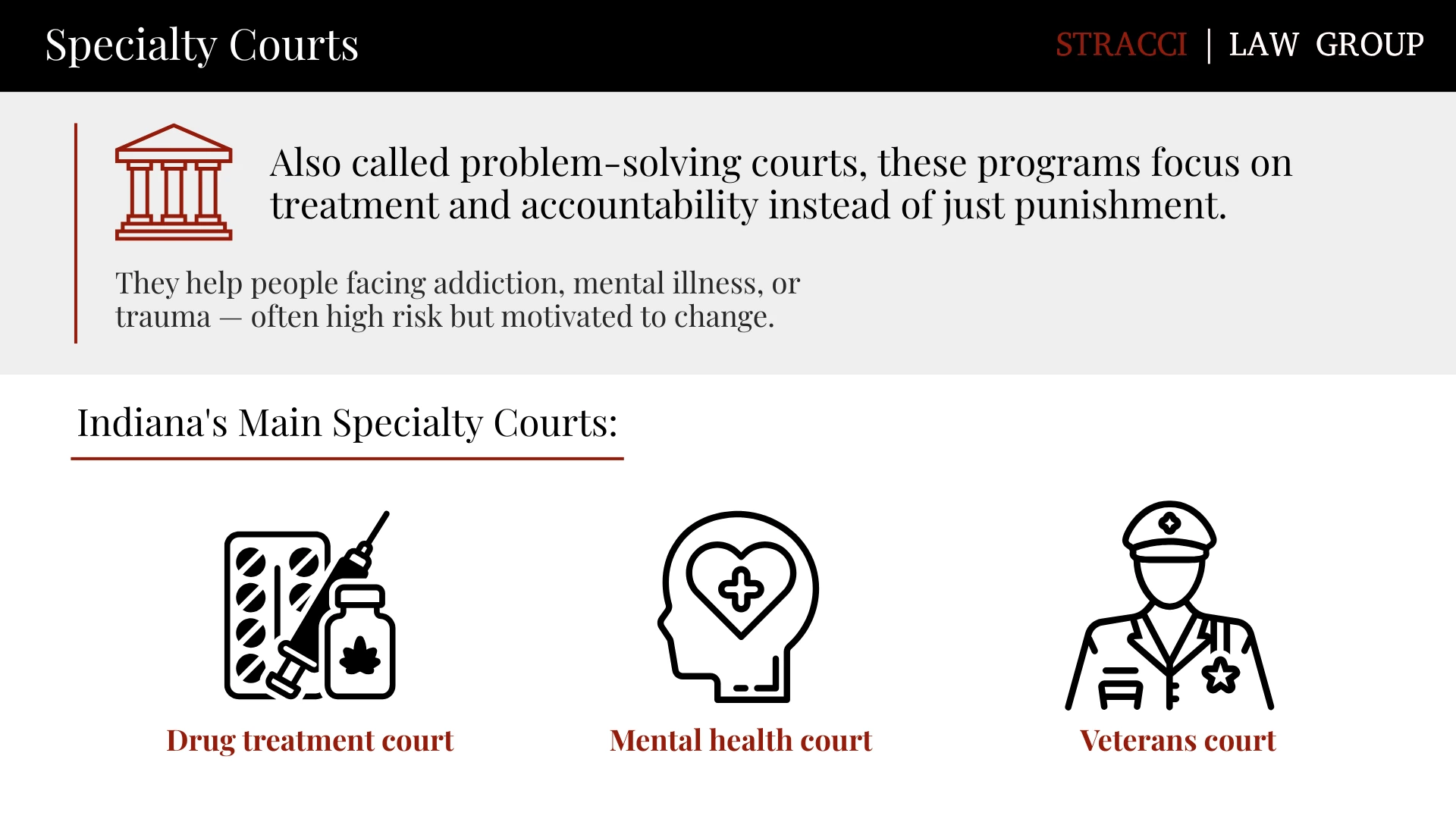
The most common types of specialty courts in Indiana include:
- Drug treatment court
- Mental health treatment court
- Veterans treatment courts
Each court is tailored to a specific population but operates with the same core components: structured supervision, intensive treatment, team-based case management, and regular check-ins with a judge.
Drug Treatment Court
In a drug treatment court, participants are usually facing charges tied to substance use, like drug possession or related crimes committed to support an addiction. These courts operate under the belief that jail isn't the best answer for addiction.
Participation typically involves:
- Mandatory drug testing: Regular and often random drug testing to monitor compliance and ensure sobriety.
- Substance abuse treatment: Participation in evidence-based treatment programs, such as individual or group counseling, therapy, and/or medication-assisted treatment, tailored to the individual's specific needs and the severity of their addiction.
- Counseling and therapy: Addressing underlying issues that may have contributed to substance abuse, such as trauma, mental health problems, or coping mechanisms.
- Judicial supervision: Regular appearances before a judge to monitor progress, address any challenges, and provide support and accountability.
- Community support: Connection to community resources and support networks to aid in the recovery process.
Noncompliance can result in sanctions, including jail time or removal from the program. But successful completion often means the charges are reduced or even dismissed.
Mental Health Court

For individuals whose offenses are tied to mental health disorders, Indiana’s mental health treatment courts provide a way forward that doesn’t rely on incarceration. These programs recognize that criminal behavior is sometimes a symptom of untreated or poorly managed mental illness.
These courts focus on getting people the help they need, which might include:
- Mental health evaluations: Comprehensive evaluations to assess the nature and severity of the mental health condition and its link to the criminal offense.
- Therapy and counseling: Individual or group therapy to address underlying mental health challenges, improve coping mechanisms, and develop healthier behaviors.
- Medication management: Assistance in managing medication as prescribed by a mental health professional.
- Case management: Ongoing support and assistance in navigating the healthcare system and accessing necessary resources.
Participants are held accountable, but with an understanding that progress may not be linear. The goal is long-term stability, not punishment. Just like with Drug Treatment Court, noncompliance can result in sanctions, including jail time or removal from the program. But successful completion often means the charges are reduced or even dismissed.
Veterans Treatment Courts
Veterans treatment courts are built around the understanding that service-related trauma, including PTSD, TBI, and substance use disorders, can play a significant role in criminal behavior. These courts offer an alternative to traditional prosecution for veterans, focusing instead on rehabilitation and reintegration.
What makes these courts unique is the inclusion of mentorship and peer support from other veterans. The structure is similar to other specialty courts, with strict supervision, individualized treatment, and regular check-ins with the judge. However, the culture of the program is designed to reflect military values and understanding.
Participants often receive services through the VA or other providers. These courts typically include:
- Specialized counseling: Addressing issues such as post-traumatic stress disorder (PTSD), traumatic brain injury (TBI), and other service-related mental health conditions.
- Mentorship: Pairing veterans with mentors who understand their experiences and can provide guidance and support.
- Community service: Engaging in community service projects to foster a sense of responsibility and community reintegration.
- Case management: Support and assistance in navigating various services and resources.
Like other programs, successful completion can result in reduced charges or complete dismissal.
How Specialty Courts Are Different from Traditional Courts
In traditional courts, the primary goal is to determine guilt and assign punishment. It’s largely an adversarial process, with the prosecutor and defense attorney operating on opposite sides.
Specialty courts, on the other hand, use a collaborative approach. The prosecutor, defense attorney, treatment providers, judge, and court officials all work as a team. Instead of fighting over guilt or punishment, they’re focused on helping the participant succeed.
Key differences include:
- Treatment-focused vs. punishment-focused
- Ongoing case management
- Frequent court appearances for accountability
- Rewards and sanctions based on behavior
Who Can Participate?

Not everyone qualifies for a specialty court. Eligibility usually depends on:
- The type of crime (typically non-violent)
- Risk assessment results
- A willingness to engage in intensive treatment
A judge, prosecutor, or defense attorney can initiate a referral, but final acceptance often depends on a screening team.
And make no mistake, these programs are rigorous. They require serious commitment and a willingness to change. However, for those who persevere, the outcome can be life-changing.
Why Specialty Courts Matter
These courts don’t just help individual participants — they benefit the entire community. By treating addiction, supporting mental health, and helping veterans reintegrate into society, they help reduce crime and ease the burden on jails and prisons.
The result? Fewer people are stuck in cycles of arrest and incarceration, and more people are leading productive lives. That’s the kind of problem-solving our justice system needs more of.
Get the Help You Deserve at Stracci Law Group
If you or someone you love is facing criminal charges and struggling with mental health, addiction, or the aftermath of military service, you may have options outside of traditional prosecution.
At Stracci Law Group, we work with clients throughout Northwest Indiana to pursue specialty court referrals where appropriate. Would a specialty court help you avoid conviction and get the support you need? Let’s talk. Call us at (219)-525-1000 or request a free consultation today.